PayPal payments: what it is, how it works, and why to integrate it into your ecommerce
What is PayPal?
The global payment method for online stores
PayPal is one of the most widely known and used online payment gateways in the world, allowing individuals and businesses to send and receive money quickly and securely. Its offerings include payments with PayPal balance, credit and debit cards, and payments linked to bank accounts, all via mobile or desktop.
Founded in 1998 as Confinity, it adopted the name PayPal in 2001. Today, it is a global reference for digital payments, present in over 200 countries and regions and supporting more than 25 currencies.
For many online merchants, accepting PayPal is key to selling internationally and increasing buyer trust during checkout. Now, we will explain you all you need to know about this payment method.
How PayPal payments work?
PayPal works by linking the user’s account to a funding source. These sources can be:
- Bank account: the amount is charged directly from the user’s bank account.
- Credit or debit card: ideal for international purchases or fast transactions.
- PayPal balance: functions as a digital wallet within the platform.
When the customer makes a payment, they authorize the transaction from their PayPal account, without sharing banking or card details with the merchant. This allows PayPal to act as an intermediary, enhancing security, reducing friction, and improving the shopping experience.
PayPal payments in ecommerce
PayPal, designed specifically for online payments, simplifies the checkout process in digital stores, offering a fast, secure, and frictionless experience. The usual payment flow works as follows:
- The customer selects PayPal as the payment method at checkout.
- They are redirected to the PayPal platform, where they log in with their email and password.
- The customer selects the funding source and authorizes the payment directly from their PayPal account.
- PayPal processes the transaction and sends the merchant immediate confirmation, without the merchant handling sensitive banking data.
PayPal payments in physical stores
Although PayPal is primarily designed for online environments, it also offers solutions for in-person payments via QR codes or pay by link. Its use in physical stores is lower and complements, rather than replaces, card terminals, enabling fast mobile payments in events or small businesses.
- The merchant generates a QR code or pay by link via PayPal.
- The customer scans the QR code or accesses the link from their mobile device.
- The customer confirms the amount and authorizes the transaction via their PayPal account.
- The operation is validated in seconds, and the merchant receives instant confirmation.
- Once the payment is confirmed, products or services can be delivered without the merchant handling the customer’s card or wallet.
Advantages of accepting PayPal payments
Advantages of paying with PayPal (customer)
- Less friction: no need to enter card details for each purchase.
- Security and trust: encryption, fraud protection, and buyer dispute resolution.
- Mobile and web management: track and pay all transactions from a single account.
- Global acceptance: works in stores worldwide, enabling international purchases.
Advantages of accepting payments with PayPal (merchant)
- Higher conversion at checkout: PayPal’s popularity and security increase buyer confidence.
- Reduced fraud: the platform verifies documentation and prioritizes fraud protection.
- Immediate payment confirmation: transactions are validated instantly, enabling faster order and shipment management.
- Easy integration: PayPal integrates with major ecommerce platforms (PrestaShop, WooCommerce, Shopify).
- Access to international customers: sell globally without worrying about multiple banks or currency conversion.
PayPal installment payments
A key feature of PayPal is the ability to offer installment payments directly at checkout, part of Buy Now, Pay Later (BNPL) solutions, allowing customers to split their purchase into multiple payments:
- Pay in 3 installments: for purchases between €30 and €2000, with no interest. The first installment is paid at the moment of purchase, with the remaining installments on later dates.
- Pay in 6, 12, or 24 installments: for purchases between €1200 and €2999. Customers can finance their purchase with monthly payments, which may include interest.
When a user selects PayPal at checkout, they may see the option to pay in full or in installments. According to PayPal, 22% of customers using BNPL make repeat purchases at the same store.
How installment payments work?
- The customer logs into their PayPal account.
- If eligible, they see the option to pay in multiple installments.
- The customer selects the available plan and confirms the transaction.
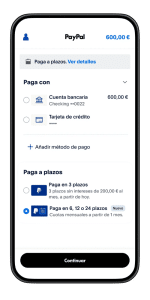
There, they can choose the available payment plan and confirm the transaction. In this way, PayPal pays the full amount to the merchant, while the customer pays the installments to PayPal afterwards.
Thanks to this feature, PayPal not only acts as a payment method but also increases the average ticket and customer loyalty, offering greater flexibility and facilitating higher-value purchases.
Sectors where PayPal boosts conversion
PayPal is a widely used payment method that can be integrated into almost any type of business. However, its impact on conversion is particularly significant in certain sectors:
International ecommerce
Online merchants selling in multiple countries benefit from PayPal’s global trust. Its acceptance in multiple currencies and the fraud protection it offers increases the perceived security for buyers. This trust boosts the conversion rate for cross-border sales.
Digital services and recurring payments
Software platforms, online courses, streaming services, or subscription apps require recurring payments. With PayPal, users can complete transactions without friction, which helps retain customers and increase subscription volumes.
Marketplaces
On platforms with multiple sellers, PayPal allows centralized and secure collection of payments, increasing buyer trust and fostering higher sales volumes.
Medium/high-ticket stores
Thanks to PayPal’s installment payment option, customers can finance more expensive purchases. This leads to a higher average order value and increases the probability of conversion, while the merchant receives the full payment without assuming financial risk.
What does integrating PayPal into your e-commerce with PaynoPain entail?
We have broken down how PayPal works and the benefits it provides to customers and merchants. If you are still wondering what integrating PayPal as a payment method in your business involves, here’s what you need to know:
Quick and easy setup
Activating PayPal in your virtual POS with PaynoPain is an agile process without technical complications. The payment gateway allows you to configure and start accepting payments immediately, without long developments or interruptions to your ecommerce.
Compatibility with your ecommerce platforms
PayPal integrates smoothly with major ecommerce platforms such as PrestaShop, WooCommerce, and Shopify. This means you can start processing payments without pausing your online store, ensuring your customers continue shopping seamlessly.
Centralized payment management
With PaynoPain, all your transactions are managed from a single real-time control panel. This allows you to:
- Automatically reconcile payments, reducing administrative errors.
- Generate detailed reports on sales and transactions.
- Centralize all payment information, simplifying daily operations and freeing time to focus on other strategic areas of your business.
Access to international customers
Adding PayPal to your store as a payment method opens the doors to customers worldwide, as PayPal allows receiving payments in multiple currencies safely and reliably. This means you can sell globally without complications related to accepting international payments, all managed from a single PayPal account.
How to integrate PayPal into your virtual POS and sell internationally
Accept PayPal in your online store and sell to customers around the world
In short, integrating global payment methods is essential to increase acceptance and boost your store’s revenue. PayPal is one of them, and with the payment gateway provided by PaynoPain, you can achieve it.
Contact us to learn more and integrate it into your virtual POS thanks to PaynoPain’s technology.



At PaynoPain, we collaborate with companies that share our vision of innovation, quality, and technological excellence. If you offer complementary solutions or want to distribute our products, together we can go further. We offer you support, training, and real opportunities for joint growth, with global impact.