SEPA
What does SEPA mean?
SEPA (Single Euro Payments Area) is a space where consumers and businesses can make payments and collections in euros under the same basic conditions, both within and across national borders between countries that are part of this area.
How does the SEPA area work?
The SEPA area is designed so that transactions between users in member countries are carried out with greater efficiency, speed, and security. It unifies standards and rules so that electronic payments are processed in a harmonized manner across all participating countries.
Types of SEPA transactions
Within the SEPA area, there are several types of payments that allow moving euros between bank accounts under uniform conditions, both domestically and internationally:
-
Standard SEPA transfers
The most common type of payment for sending or receiving euros between accounts in different SEPA member countries using a standard IBAN. These transfers are usually processed within one business day.
-
SEPA instant transfers
Also known as SEPA Instant Credit Transfer, these allow funds to be transferred within seconds, available 24/7 throughout the year, including weekends and holidays, provided that participating banks support it.
-
SEPA direct debits
This type of transaction allows a business or provider to collect payments directly from a customer’s bank account, provided prior authorization has been given. It is commonly used for subscriptions, service invoices, or recurring payments.
-
Harmonized card payments
Although not a transaction type per se like transfers or direct debits, cards issued under the SEPA scheme operate under uniform rules, which facilitates cross-border euro payments and helps simplify and standardize card acceptance across the area.
Advantages of the SEPA area
- Uniform rules: All payments are executed under the same rules, eliminating differences between countries.
- Greater security: Complies with European data protection and fraud prevention standards.
- Speed and operational efficiency: Simplifies payment and bank reconciliation management and reduces administrative costs.
- Customer convenience: Whether sending money domestically or to another SEPA member, the conditions and processes remain the same.
Which countries belong to the SEPA area?
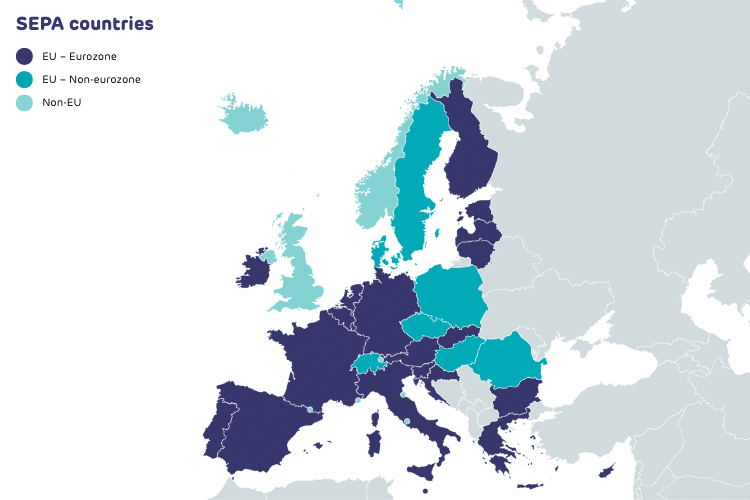
The SEPA area consists of 36 countries:
- The 27 EU member states, including those using the euro (Germany, Austria, Belgium, Bulgaria, Cyprus, Croatia, Slovakia, Slovenia, Spain, Estonia, Finland, France, Greece, Ireland, Italy, Latvia, Lithuania, Luxembourg, Malta, Netherlands, Portugal) and those with their own currency (Denmark, Hungary, Poland, Czech Republic, Romania, Sweden).
- Other territories that adhere to the agreement: Andorra, Iceland, Liechtenstein, Monaco, Norway, United Kingdom, San Marino, Switzerland, and the Vatican City State.