Guest journey
What is the guest journey?
The guest journey refers to all the stages a customer goes through before, during and after staying at a hotel or tourist accommodation. It covers everything from searching for accommodation and booking a room to sharing feedback after their stay. It is also known as the hotel customer journey.
In the hospitality industry, understanding the guest journey helps businesses identify guests’ needs at every stage, improve customer service and simplify processes such as bookings, payments and check-in.
Below, we explain the main stages of the guest journey, why they matter and how digital payments can improve the overall guest experience.
What are the stages of the hotel guest journey?
The hotel guest journey can be divided into five main stages:
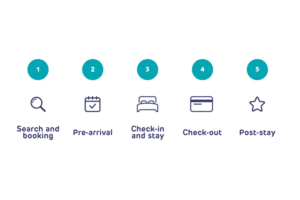
1. Search and booking
Guests search for accommodation, compare prices and make a reservation. A user-friendly booking engine and a secure payment gateway help simplify the booking process and reduce abandoned reservations.
2. Pre-arrival
Once the booking is confirmed, guests can complete online check-in, make advance payments or book additional services, such as breakfast or airport transfers.
3. Check-in and stay
During their arrival and stay, guests use the hotel’s services. Integrating payments with the Property Management System (PMS) helps speed up transactions at reception and manage additional charges.
4. Check-out
Guests finish their stay and settle any outstanding payments. Automating payments and invoicing helps reduce waiting times and prevent errors.
5. Post-stay
After check-out, hotels can request reviews, send personalised offers and stay in touch with guests to encourage future bookings.
Why is optimising the guest journey important?
Optimising the hotel guest journey helps improve guest satisfaction while making hotel operations more efficient. The main benefits include:
- Improving the guest experience at every stage of their stay.
- Reducing waiting times and manual tasks.
- Tailoring services to guests’ preferences.
- Creating additional revenue opportunities through extra services.
- Encouraging guest loyalty and repeat bookings.
How can digital payments improve the guest journey?
Payments play an important role throughout the guest journey, from booking to check-out. Integrating payment solutions with hotel management systems helps simplify operations and provide a smoother experience.
Here are some ways to optimise the guest journey through digital payments:
- Simplifying online payments with a fast booking process and a secure payment environment adapted to different devices.
- Offering different payment methods that match guests’ preferences.
- Integrating payments with the PMS, connecting payment and hotel management systems to speed up transactions at reception and record charges during the stay.
- Using tokenisation to protect card details and manage future authorised charges, such as no-show fees.
- Automating payments for additional services and outstanding balances.
Combining these solutions helps hotels reduce manual tasks, minimise errors in payment management and offer a more convenient payment experience, while keeping security and control over operations. You can learn more about our payment solution for hotels.
More information about the guest journey
Digital payments play an important role in the guest experience and in the efficiency of hotel processes. If you want to learn more about the guest journey and how to improve the guest experience through your payment strategy, we recommend reading this article: Hotel payments: how to improve the guest experience at every stage of the journey.


